


Ever sat in a casino feeling invincible, only to walk away with nothing but that nagging sense you almost won? Been there, done that. The first time I played a slot (an old-school pirate-themed one), I remember the bells going off, the lights dancing, and—poof!—my $20 was gone in a blur. It felt random, yet somehow personal, as if the machine was toying with me. Turns out, I wasn’t imagining things. Modern slot machines do much more than entertain; they are engineered to hijack our brains. Let’s take a curious (and sometimes offbeat) stroll through the hidden mind games of the casino floor—and meet the ordinary people caught in their web.
Bright Lights, Hidden Traps: How Slot Machines Warp Our Minds (Casino Psychology Unpacked)
As I step onto a casino floor, the world blurs into a swirl of flashing lights and relentless beeps. It’s easy to get swept up in the excitement—rows of slot machines, each promising a shot at fortune with every spin. But beneath the surface, Casino Psychology reveals a more unsettling truth: these machines are designed to manipulate, not just entertain.
My first time at a slot machine, I remember the rush when the reels stopped just one symbol away from a jackpot. That near-miss made my heart race, and I felt an irresistible urge to play again. Research shows this isn’t just luck or coincidence. Slot machines use near-miss outcomes to trigger dopamine spikes in the brain, the same chemical that fuels addictive behaviors. The “almost win” is a calculated feature, not a fluke.
Modern Slot Machines have evolved far beyond the old one-armed bandits. Since the 1980s, manufacturers have used virtual reel mapping—a technique that makes winning combinations appear more likely than they really are. As Robert Simpson, CEO of the Ontario Problem Gambling Research Centre, puts it:
Slot machines create an illusion of favorable odds.
On most machines, the first two reels might show frequent winning symbols, but the third reel—the one that counts—is rigged to rarely land a jackpot. US Patent 4 448 419 even admits these machines are built to seem more generous than reality allows. Studies from the University of Waterloo found that slots appear to promise 2–5 times your wager, yet the house always profits. It’s no wonder Problem Gamblers are drawn in by these illusions.
Other tricks are everywhere: oversized winning symbols, random reward surges, and stop buttons that make you feel in control—even though the outcome is already decided. These features work together to distort our perception, making us believe we’re just one spin away from winning big.
Experts argue that these manipulations are at the heart of Gambling Effects Brain research. Near-miss outcomes and machine design foster addiction, even in people with no prior history of gambling problems. The reality? Ordinary people become hooked, not because they’re flawed, but because the game is rigged to keep them coming back.
Slot Machine Design
Virtual Reel Mapping
Near-Miss Outcomes
Oversized Symbols
Stop Buttons
Cognitive Distortion & Addiction

Counting the Cost: Who’s Really Losing? (Gambling Addiction Statistics & Financial Fallout)
Step into any Canadian casino, and you’ll see the bright lights and hear the cheerful chimes of slot machines. But behind the noise, the real story is told in numbers—and it’s not pretty. Research shows that 60% of gaming machine revenue in Canada comes from problem gamblers, not casual players. That’s a staggering figure, and it’s one the gambling industry rarely advertises.
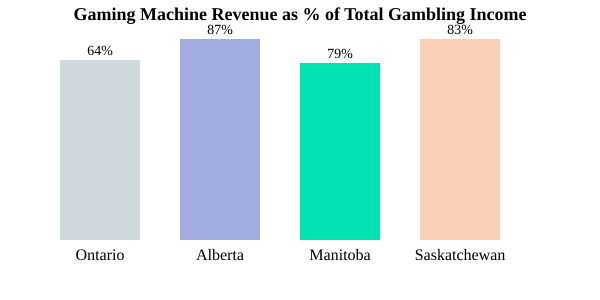
Let’s break it down. In provinces like Manitoba, Saskatchewan, and Alberta, electronic gaming machines (slots and VLTs) account for 79%, 83%, and 87% of all gambling revenue, respectively. In raw dollars, Alberta alone pulls in $2.2 billion from these machines, while Manitoba and Saskatchewan rake in $615 million and $535 million. Ontario, with its 22,000 slot machines, reported a jaw-dropping $4.7 billion in gambling revenue in 2006/07—$3 billion of that from slots.
What’s even more surprising? Provinces with fewer machines often have higher per capita access. Take Newfoundland: with just 2,500 VLTs, its per-person rate is three times higher than Ontario’s. The impact is clear—addiction risk rises with machine density and access.
I’ve seen the fallout up close. A friend of mine started with small slot wins—just enough to feel like quitting would mean missing out. Before long, his debt spiraled. It’s a story echoed in studies: a 2003 Nova Scotia survey found that half of VLT players were at risk for problem gambling. And in Alberta, 71% of those seeking help for gambling addiction said their problems only began after using VLTs.
Roger Horbay: “We’ve been treating these people like they’re messed up, but it’s the machines that are messing them up.”
The Gambling Addiction Statistics don’t lie. The gaming machine revenue stream is built on the backs of problem gamblers. The gambling industry may call it entertainment, but the financial and emotional fallout tells a different story.

Wired for Addiction: What Slot Machines Teach Our Brains (Gambling Effects Brain & Mental Health)
Stepping into a casino, I’m instantly hit by the chaos—flashing lights, upbeat jingles, and the constant clatter of slot machines. It’s easy to forget, in all this noise, that these machines are more than just entertainment. They’re engineered to tap into the very core of our brains, triggering the same dopamine rush you get from chocolate or a social media ‘like.’ But here’s the twist: the unpredictable highs of slot play are uniquely addictive, and it’s not just “problem personalities” who fall into the trap.
Research on Gambling Effects Brain shows that modern slot machines are designed to condition “normal” brains. It’s the frequency of wins, the near-misses, and the hypnotic visual feedback that keep us coming back. I remember after a weekend lost to slots, I started seeing patterns everywhere—crosswalk signals, phone games, even the way my coffee maker beeped. It’s wild how quickly your brain starts searching for the next “win,” even outside the casino.
Addiction therapists now see more regular people developing gambling addiction—not just those with a history of mental health issues. The secret? Near-misses. These almost-wins manufacture hope, fueling the “just one more spin” mentality. The supposed “skill” of slots is a myth; the games are engineered to feel beatable, amplifying risk and compulsion.
The mental health fallout is serious. Anxiety, debt, depression, and even suicide are linked to compulsive gambling. Studies indicate that over 80% of gambling addicts never seek help, and for those who do, relapse rates soar above 70%. The prevalence of problem gambling among adults sits between 0.4% and 2%, but the impact ripples far wider.
Roger Horbay: “Let’s stop labeling and pathologizing them—these are normal people. Let’s look at the source of the harm.”
| Statistic | Value |
|---|---|
| Problem gamblers who do not seek treatment | Over 80% |
| Relapse rate among treated gamblers | Over 70% |
| Problem gambling prevalence (adults) | 0.4%–2% |
Ultimately, the science is clear: Slot machines are wired to exploit our brains, making gambling addiction a risk for anyone—not just the “usual suspects.” The real danger lies in the machine’s design, not the player’s character.
Regulation or Roulette? The Ongoing Battle Over Machine Design (Plus: A Shoutout to Slot Atlas.com)
Stepping into a casino, I’m always struck by the bright lights and the endless chorus of slot machines. But beneath the surface, the Gambling Industry is locked in a fierce debate over whether these machines are harmless entertainment or cleverly engineered traps. Industry leaders insist that slots are just randomized fun, not manipulative devices. Yet, as research shows, the reality is far more complicated—and the stakes are much higher for public health.
One of the most controversial features is virtual reel mapping. Imagine if a deck of cards at a blackjack table was secretly stacked. That would be illegal. But in slot machines, stacking the odds through virtual reels is routine. This practice creates the illusion of fair play while quietly tilting the odds against the player. Bill Rutsey, CEO of the Canadian Gaming Association, argues,
‘The whole issue there is did you win or didn’t you win…whether the reel is balanced or unbalanced, you end up with the same result.’
But critics and mental health experts disagree. They see these features as a direct cause of the high Problem Gambling Prevalence linked to slots.
Here’s a quick look at the numbers:
| Statistic | Value |
|---|---|
| Problem gambling rate (Canada) | 1% of population |
| Problem gamblers who play slots | 75% |
Countries like Australia and New Zealand have taken bold steps, banning virtual reel mapping and requiring machines to display true expected loss rates. These policies put the focus on Gambling Addiction Prevention and transparency—something Canada and many U.S. states have yet to fully embrace. Consumer protection is lagging, even as evidence mounts that slot machine design fuels addiction among “normal” people, not just those with a history of risky behavior.
For players in Illinois, there’s a glimmer of hope: Slot Atlas.com is making it easier to find information and support, promoting responsible play and transparency. Ultimately, the fight over slot machine regulation isn’t just about personal responsibility. It’s about policy, informed choice, and giving everyone access to Gambling Addiction Resources—before the next spin turns into a lifelong struggle.
TL;DR: Slot machines are designed with psychological tricks to keep you playing, and the real risk isn’t just to those with a predisposition for addiction—the danger extends to us all. Want to protect yourself? Stay savvy, get informed, and check out community resources like Slot Atlas.com before heading to your next gaming parlor.
